

What it’s really like to spend 24 hours in Jordan’s legendary desert
Everyone asks the same question: “What’s Wadi Rum actually like?”
And honestly? Words don’t do it justice. But after years of planning trips to this UNESCO World Heritage desert, we’ve learned that the best way to explain Wadi Rum is to walk you through a day there—hour by hour, moment by moment.
This isn’t marketing. This is what actually happens when you spend a day and night in one of the world’s most spectacular desert landscapes.
You wake to absolute silence.
Not “quiet neighborhood” silence. Not “peaceful countryside” silence. Desert silence—the kind where you can hear your own heartbeat, where the only sound is wind moving across sand.
If you chose to sleep outside (and we highly recommend it), you’re already looking at stars. If you slept in a tent, you unzip the entrance to cold morning air and a sky that’s that deep blue-black that only exists right before sunrise.
The temperature has dropped significantly overnight. In spring and fall, mornings hover around 10-15°C (50-60°F). In winter, it can dip near freezing. You’re grateful for the layers you brought.
Someone in camp is already awake—usually your Bedouin host, preparing the morning fire. They’ll suggest hiking up a nearby sand dune for sunrise, and you should absolutely do it.
The hike is harder than it looks. Your feet sink with each step. Your calves burn. But when you reach the top and turn around, you forget all of it.
The desert doesn’t just change color at sunrise—it transforms. Shadows carve valleys you didn’t see in darkness. Rock formations shift from black silhouettes to rust-red monuments. The sand turns from grey to copper to gold. The temperature rises 10 degrees in twenty minutes.
Your camera stays in your pocket because you know—some moments are meant to be felt, not photographed.
Back at camp, breakfast is waiting around the fire:
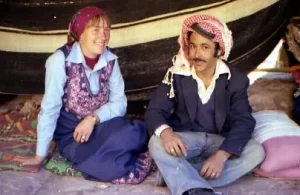
You eat sitting on cushions, talking with your Bedouin hosts about everything and nothing. Where they’re from (usually they’ve lived in Wadi Rum for generations). What life was like before tourism. How the desert changes with seasons.
This isn’t a performance. This is breakfast. But somehow, it’s perfect.
Your guide loads everyone into a 4×4 pickup—the kind with bench seats in the truck bed, no roof, maximum wind in your face.
And then you’re off.
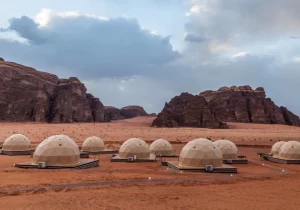
For the next several hours, you’re exploring landscapes that genuinely don’t look real. This is why they filmed The Martian, Dune, Star Wars, and countless other sci-fi movies here. It actually looks like another planet.

Lawrence’s Spring (Ain Abu Aineh) A small spring hidden in rock crevices where T.E. Lawrence supposedly stopped during the Arab Revolt. Water in the desert feels miraculous. The spring creates a small pool surrounded by reeds—an impossible oasis.
Khazali Canyon Narrow slot canyon with walls covered in ancient Thamudic petroglyphs—carvings made by human hands thousands of years ago. Your guide will point out figures of people, animals, and symbols whose meanings have been lost to time. You’re reading messages from civilizations that existed before Rome.
Red Sand Dunes Massive dunes of iron-oxide-rich sand that look like they’ve been airbrushed orange-red. Your guide will stop here for sandboarding if anyone’s interested. It’s exactly what it sounds like: surfing down sand dunes. It’s harder than snowboarding, more forgiving than concrete, and absolutely worth doing.
Umm Fruth Rock Bridge One of Wadi Rum’s natural rock arches—a massive bridge formed by millennia of wind and water erosion. You can climb to the top (carefully) for panoramic views of the desert. Some people propose up here. Others just sit in silence.
Little Bridge (Al Ramal Bridge) Smaller but more accessible rock bridge where you can walk underneath and feel the weight of geological time pressing down on you. The rock formations here look sculpted, deliberate, impossible.
Throughout the drive, your guide stops constantly—not because the itinerary says to, but because they know every story, every hidden spot, every angle where the light hits just right. They grew up here. Their grandfather grew up here. This isn’t a tour; it’s someone showing you their home.
Back at camp, something miraculous is happening beneath your feet.
Your host has been preparing zarb since early morning: digging a pit, layering hot coals, arranging pots of marinated lamb, chicken, and vegetables, covering everything with sand and more coals, burying it all.
Now, several hours later, he digs it up.
The aroma hits you first—smoky, spiced, rich. He pulls out pots of fall-apart-tender meat, caramelized vegetables, rice that’s absorbed all the flavors. You eat with your hands (there’s an art to it—use the bread as a scoop), sitting in the shade of a rock formation that’s been here for millions of years.
This is not food you can get in restaurants. This is cooking as it’s been done for centuries—low and slow, buried in earth and fire.
The afternoon is yours. Wadi Rum operates on desert time, which is to say: no rush.
Some people opt for camel rides—slow, swaying, contemplative movement across the sand. Camels were the original 4x4s out here, and riding one gives you a sense of how Bedouins traveled for generations.
Others try sandboarding if they haven’t already—racing down dunes, wiping out spectacularly, laughing like kids.
Some people just sit in the shade with tea and a book. Or nap in the cool darkness of a Bedouin tent. Or walk alone into the desert until they can’t see the camp, just to experience that particular quality of solitude.
There’s no pressure. No schedule. The desert doesn’t care about your itinerary.
As the afternoon heat begins to ease, someone will invite you for tea.
Not “tourist tea time.” Real tea, in someone’s family tent, using the same preparation methods passed down through generations. Your guide might translate stories from his uncle or father—tales about desert life, tribal history, the famous winter when it actually snowed in Wadi Rum.
You’ll learn a few words of Arabic. Someone will teach you the proper way to pour tea (high, to aerate it). You’ll hear about the changes tourism has brought—mostly positive, some complicated.
These conversations are why people say Wadi Rum changed them. Not the landscapes (though they help). The human connection. The realization that hospitality isn’t a service industry concept here—it’s cultural bedrock.
Someone suggests returning to the sand dune from this morning. Same place, completely different world.
The light at sunset is warmer, lower, more forgiving. Everything turns copper and rose gold. The shadows stretch for miles. Distant rock formations glow like embers.
The temperature drops quickly once the sun disappears. You feel the desert exhale. The wind shifts. Stars begin appearing before the sky is fully dark—first one, then dozens, then hundreds.
Dinner is communal: grilled meats, rice with spices, fresh salads, more of that incredible bread, endless tea.
You eat outside, because the stars demand it. The sky over Wadi Rum is UNESCO Dark Sky certified—one of the best places on Earth for stargazing. The Milky Way isn’t a subtle band of light. It’s a river of stars so bright it casts shadows.
Your guide points out constellations and tells you their Arabic names—names Bedouins have used for centuries to navigate at night. You see satellites crossing overhead. Shooting stars streak past regularly enough that you stop making wishes and just watch.
Someone mentions they haven’t checked their phone since yesterday. Someone else realizes they’ve forgotten what day it is. Everyone agrees this is fine.
After dinner, someone pulls out an oud—a traditional stringed instrument with a sound that seems designed specifically for desert acoustics. The music is haunting, minor-key, ancient.
Stories are told. Some translated, some in Arabic with animated hand gestures that transcend language. There’s laughter—the kind that happens when people from completely different worlds find common ground.
Your guide’s cousin might show up with more tea. A neighboring Bedouin family might visit. Conversations meander from politics to poetry to “is that constellation the same one we call [X]?”
The fire crackles. The music continues. Time loses meaning.
Eventually, the fire dies to embers. People drift toward tents or sleeping bags spread under stars.
You lie down and look up.
The silence returns—that complete, profound, desert silence. But now you’re used to it. Now it feels less like absence and more like presence.

The stars are so numerous they look fake. The air is cold enough to see your breath. The sand is soft beneath your back.
You fall asleep to nothing but wind moving across ancient rock and sand. No traffic. No screens. No notifications. Just existence, reduced to its most elemental form.
And when you wake—whenever that is—you’re different.
Not dramatically. Not obviously. But something has shifted. Some part of you that was wound tight has relaxed. Some question you didn’t know you were asking has been answered.
That’s Wadi Rum.
Spring (March-May): Perfect
Fall (September-November): Perfect
Winter (December-February): Cold but Beautiful
Summer (June-August): Hot but Doable
Essentials:
For overnight:
Leave at home:
Is it safe? Extremely. Wadi Rum Protected Area is well-managed, and Bedouin hospitality is legendary. Solo travelers (including women) regularly visit without issues.
What about bathrooms? All camps have toilets. Budget camps have shared facilities. Mid-range and luxury camps offer private options. Yes, there’s toilet paper.
Are there showers? Depends on the camp. Budget camps usually don’t (or have very basic ones). Mid-range and up typically offer hot showers. Many people just embrace being sandy for one night.
Can I charge my phone? Some camps have solar power with limited charging. Don’t count on it. Bring a power bank. Better yet, leave your phone off and be present.
What if it’s too cold/hot? Bedouins have survived here for millennia. Your hosts know how to manage temperature. They’ll provide blankets if cold, adjust schedules if hot. Trust their expertise.
Can kids do this? Absolutely. Many families visit Wadi Rum. Kids often love the adventure aspect—camels, sand dunes, stars, camping. Just bring appropriate layers and snacks they like.
Is the food safe? Yes. Bedouin hosts take food preparation seriously. We’ve sent thousands of travelers through Wadi Rum with virtually no food safety issues.
What about dietary restrictions? Most camps can accommodate vegetarian, vegan, gluten-free, halal, or kosher requests with advance notice. Tell your DMC when booking.
Here’s the thing about Wadi Rum that statistics and descriptions can’t capture:
In a world of increasing connectivity, constant notifications, and perpetual productivity, Wadi Rum offers something rare: permission to stop.
Not “slow down.” Stop.
The lack of wifi isn’t a bug—it’s a feature. The simplicity of the experience isn’t a limitation—it’s the point. The silence isn’t empty—it’s full.
People return from Wadi Rum changed not because they saw spectacular landscapes (though they did), but because they remembered what it feels like to be human in a natural environment, connected to other humans through shared experience rather than shared screens.
That’s why we include Wadi Rum in every Jordan itinerary we create. Not because it’s famous. Because it’s necessary.
Wadi Rum is typically visited as part of a larger Jordan itinerary:
5-Day Jordan Itinerary:
7-Day Jordan Itinerary:
10+ Day Jordan Itinerary:
Our recommendation: If you can, spend two nights in Wadi Rum. The first night is magical. The second night is when you fully relax and understand the rhythm of the desert.
We’ve been creating custom Jordan itineraries for years. We work with carefully vetted Bedouin camps in Wadi Rum—families we know personally, whose hospitality and authenticity we trust.
Whether you want basic camping under stars or luxury glamping with private bathrooms, we’ll match you with the right experience for your travel style and budget.
Wadi Rum isn’t just a destination. It’s an experience that stays with you—the silence, the stars, the stories, the sense of being fully present in an ancient landscape.
It’s time to stop reading about it and start planning to experience it.
Have questions about Wadi Rum or planning your Jordan trip? Contact us and our team will be happy to help. We love talking about Jordan—it’s what we do.